CASE STUDY: HABITGO
Enjoy a fun, hassle-free, and inspirational habit-building experience complemented by an AI-powered coach and gamification!

Project Background
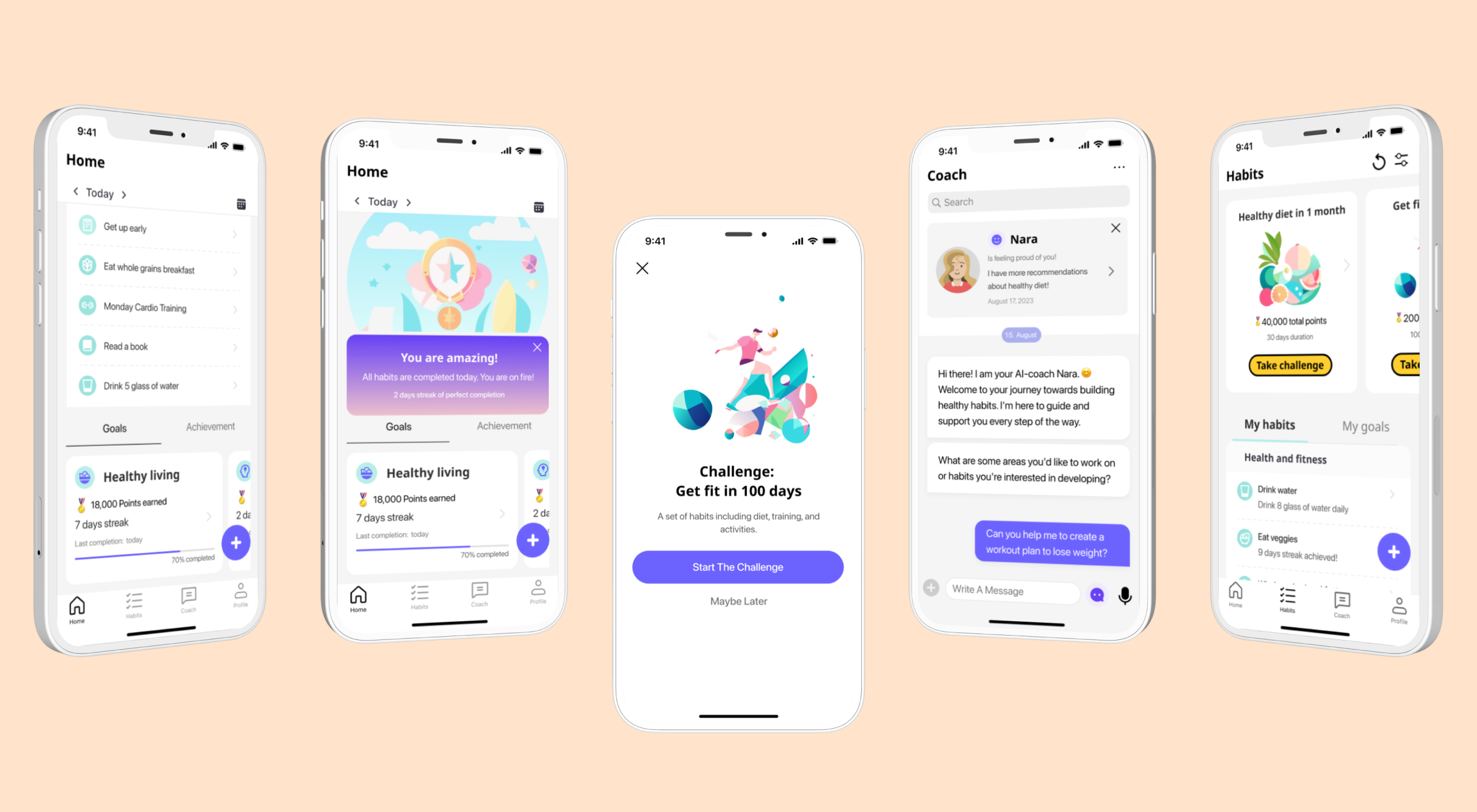
The concept behind this app design revolves around infusing gamification elements into the core habit-tracking features. By integrating immediate positive feedback, point rewards, leaderboards, and challenges, HabitGo isn't just a habit-tracking app – it's an easy-to-usethat elevates your motivation and empowers young adults to cultivate enduring, healthful habits.
This is a revival of an older project, where I've breathed fresh life into the concept and given the visuals a complete overhaul. 😊 The new version is an evolved habit tracker, now enriched with an AI-powered personal coach. Through a conversational interface, gamification elements, and the power of the GPT-4 API, HabitGO ensures that habit-building is far from dull – in fact, it's incredibly enjoyable and rewarding! 🚀🎮
My Role: UX/UI
Timeline: 4 weeks
Project year: 2023
Conceptual project
“It's like checking off a to-do list without any real motivation.“
It’s almost painful to watch how boring some habit-tracking apps can get.
Unfortunately, this isn't a problem unique to just one app. Many of the competitors in the market have fallen into the trap of offering uninspiring experiences that leave users feeling disengaged and unmotivated. It's like they forgot that building habits is all about making positive changes with positive reinforcement. I’ve taken this challenge head-on and transformed it into an opportunity. Your journey towards self-improvement deserves more than dull checkboxes – it deserves a dynamic, vibrant, and rewarding approach that keeps you motivated from day one.
The problem: Habit-tracking is boring as hell
Users
HabitGo’s primary users are young adults who want to adopt a healthy lifestyle and get into new habits. These users are individuals who need to attain or change some aspect of their old habits. For example, some users want to eat healthier, some want to work out more, and some want to learn something new and become more productive.
Research questions
I was trying to answer these research questions in the beginning:
What kinds of habits do people want to attain?
What are the most important things that will help them to develop their desired habits?
What stopped them from developing the desired habits previously?
Since there are ample research findings from psychology studies, I relied primarily on literature and secondary research. I also conducted user interviews with a few people, to understand their journeys and frustrations better and based user personas on the information gathered.
Findings
What’s essential in the habit-building process:
-Realistic Goals-
Positive reinforcement-
Cues and Triggers-
-Realistic Goals- Positive reinforcement- Cues and Triggers-


-Motivation-
Acountability-
Structured plan-
-Motivation- Acountability- Structured plan-
-Progress tracking-
A sense of achievement-
Support-
-Progress tracking- A sense of achievement- Support-
Value proposition
Habit advice from a knowledgable AI personal coach is added automatically to your task list. Make the coach your personal trainer, nutrient advisor, career coach, you name it! No more painstaking habit creation. Get a tailored task list from your coach!
Imagine crossing off tasks, earning points, and unlocking rewards that make you feel like a champ. It's habit tracking, but with a twist of fun. Get ready to enjoy the journey as much as the destination – it's time to make every step of your progress feel like a victory.
And most importantly, it’s NOT boring
Think of AI coach as your habit-building wing-person. You’ll have a buddy who cheers you on, checks in on your progress, and gives you a gentle nudge when Netflix is calling louder than your workout. Accountability makes habit building less lonely, more fun, and a whole lot more likely to stick. 🙌💪
Actionable
Accountable
Enjoyable
Early Concept
I sketched out some brainstorming ideas and basic concepts on paper, using the crazy 8’s approach.
Later, tentative wireframing ideas were drawn on paper.
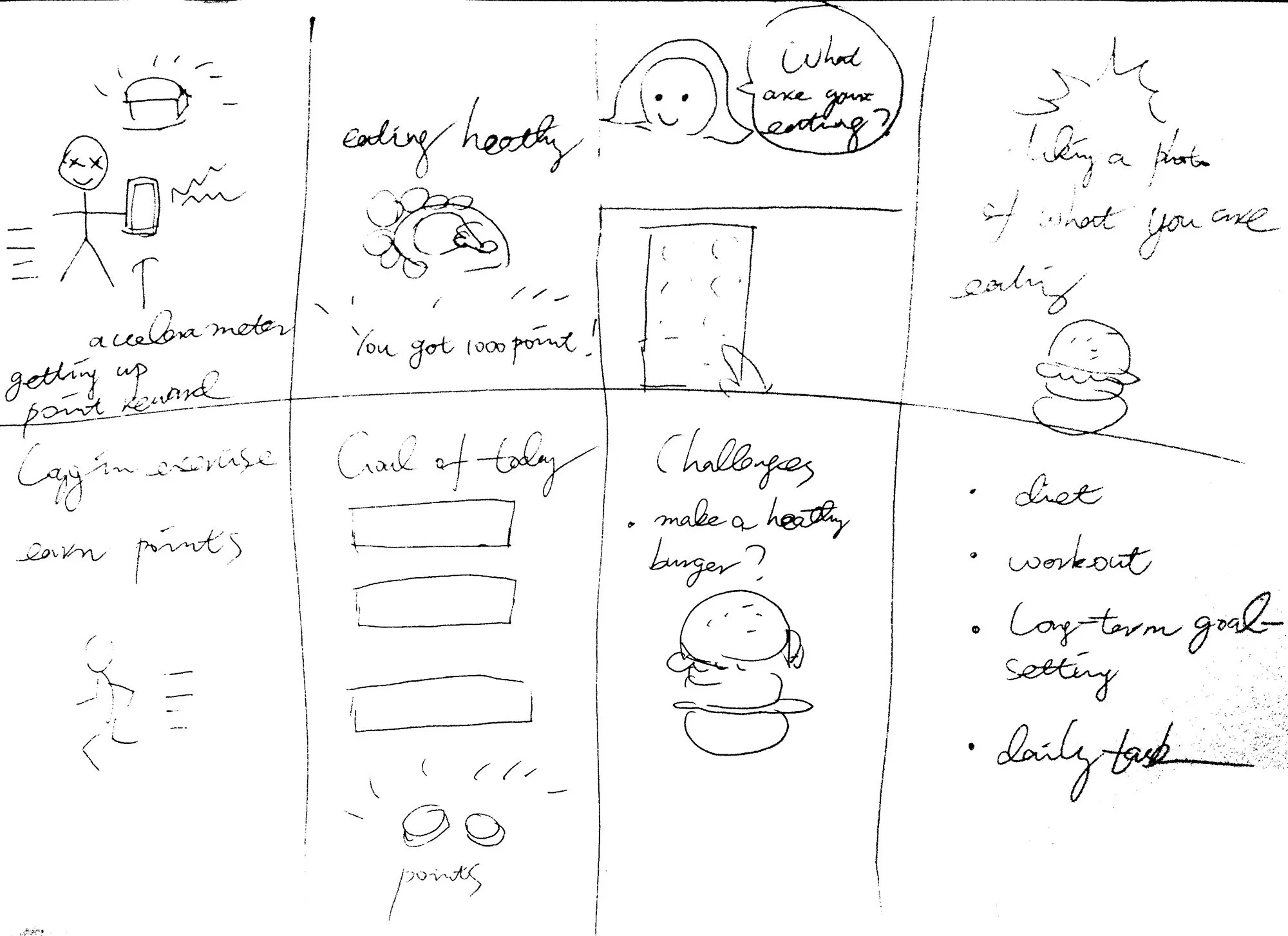
I D E A T I O N
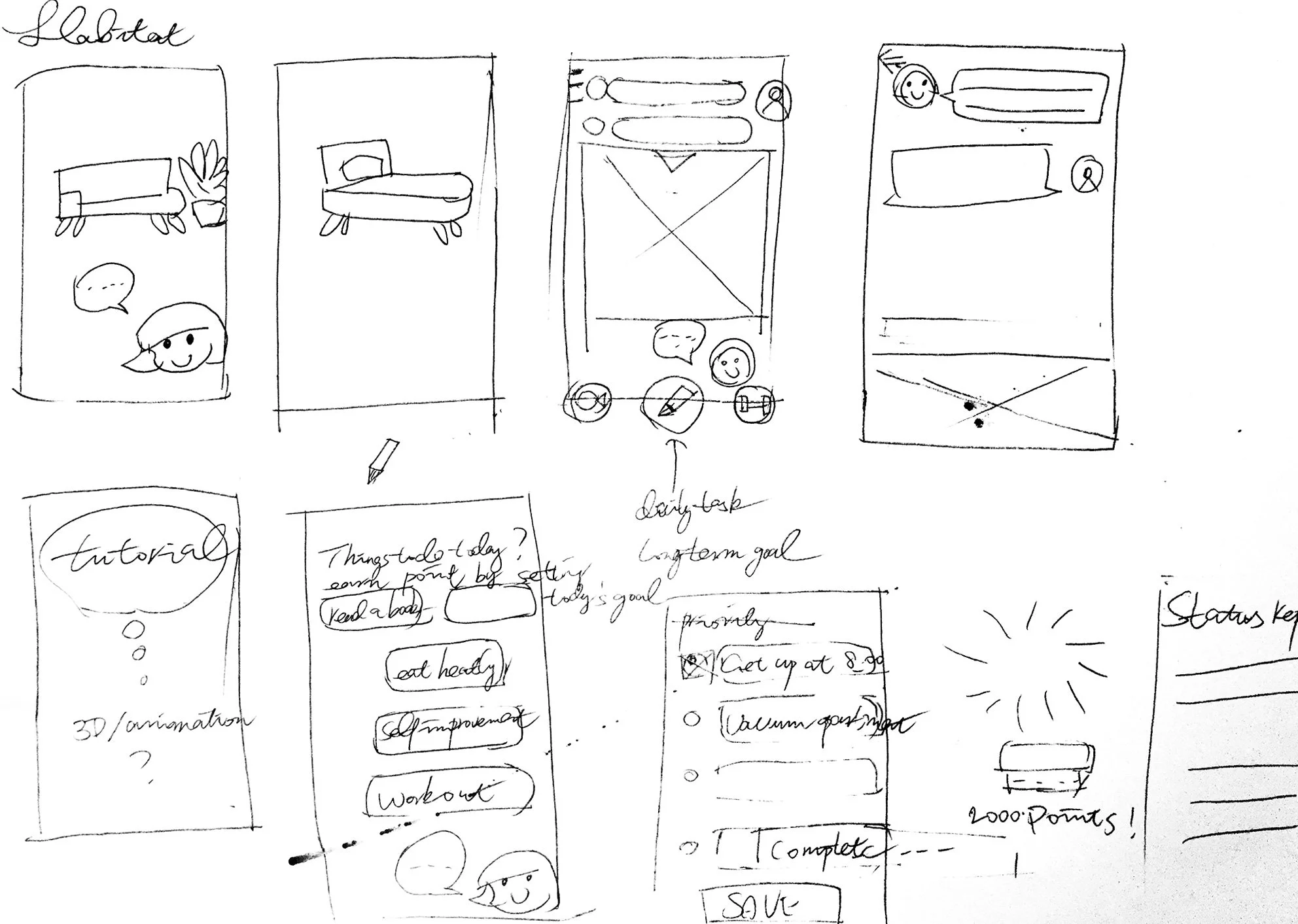
Wireframes
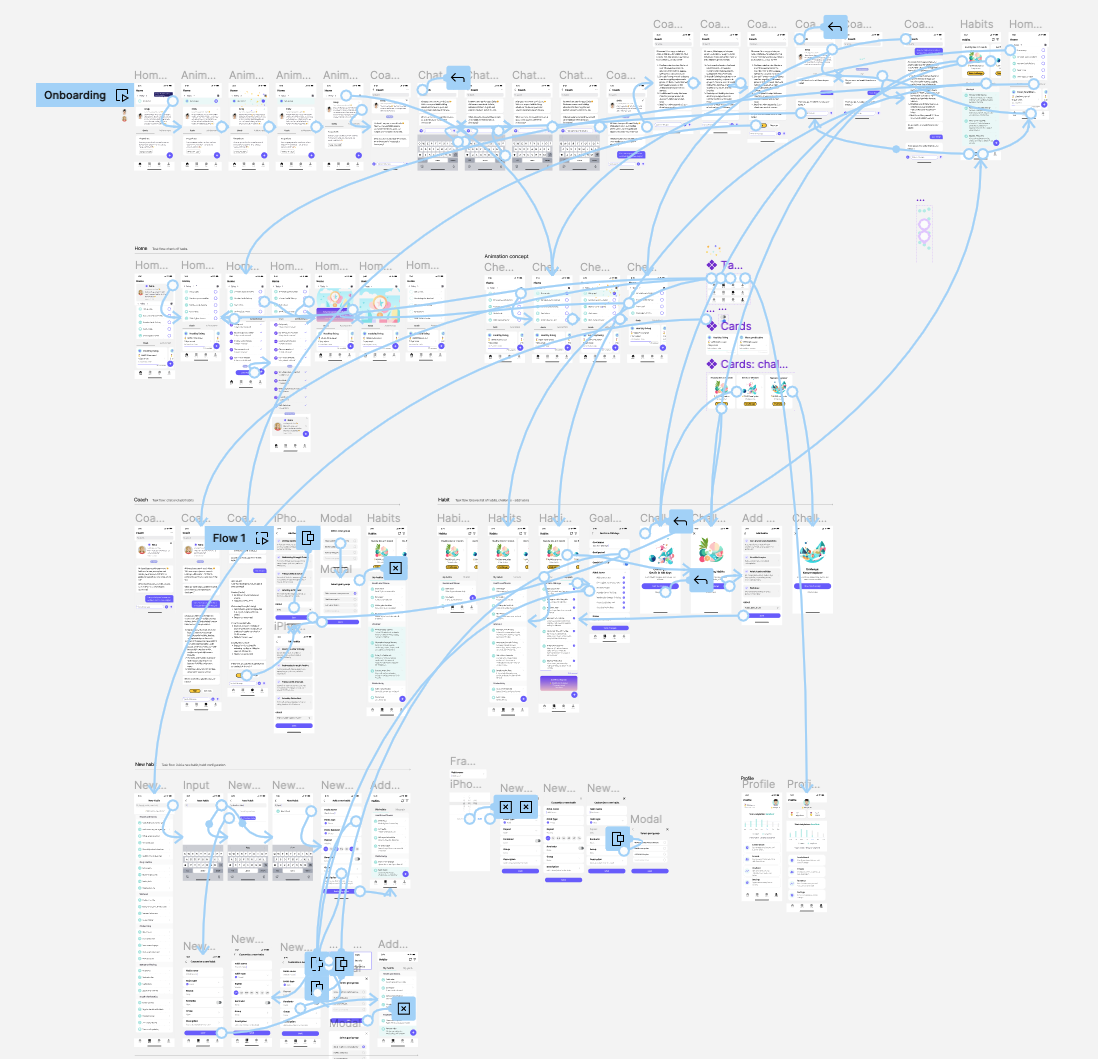
The old version of digital wireframes was created in Adobe XD based on paper wireframe ideas. In this round, I revised the old concept and added something completely new: habit recommendation from AI coach. The wireframes to the right were made in Figma, along with some preliminary flow chart and my notes.
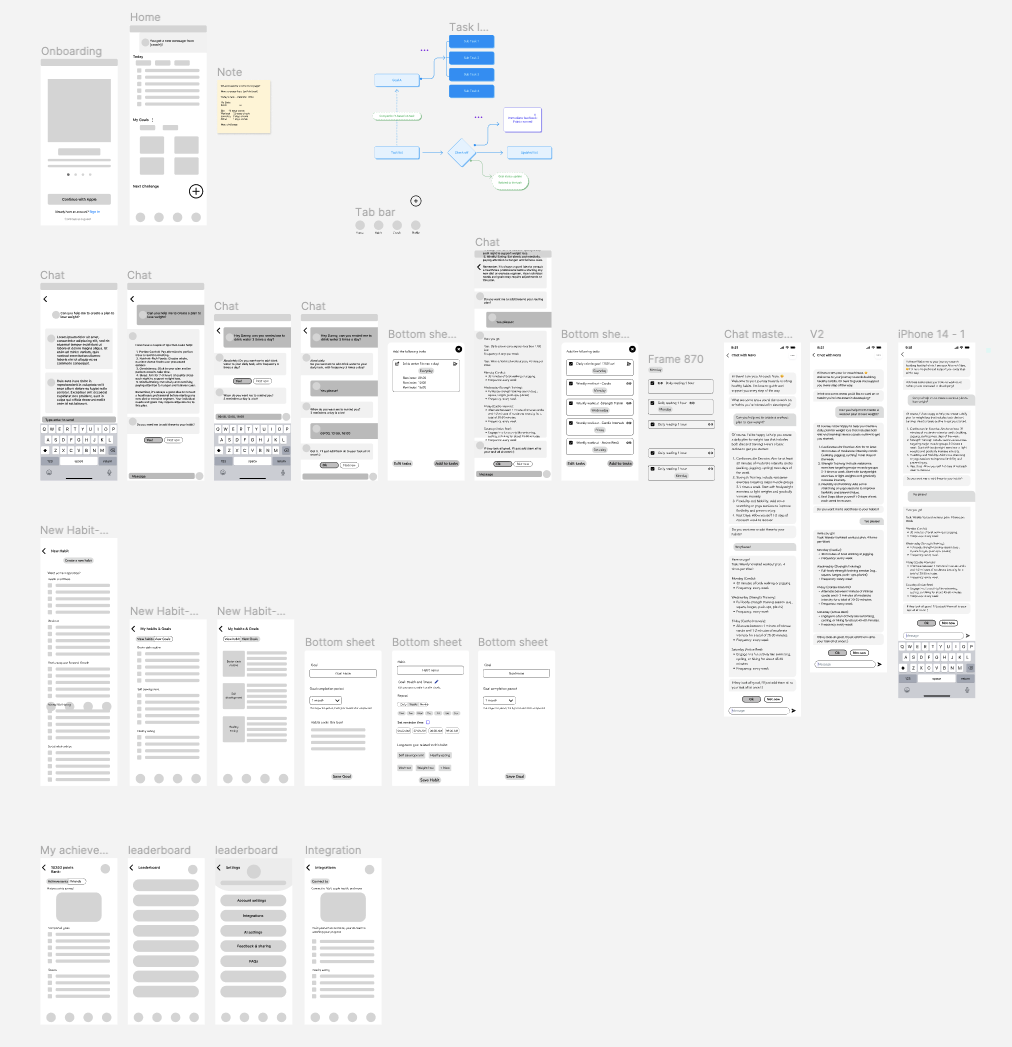
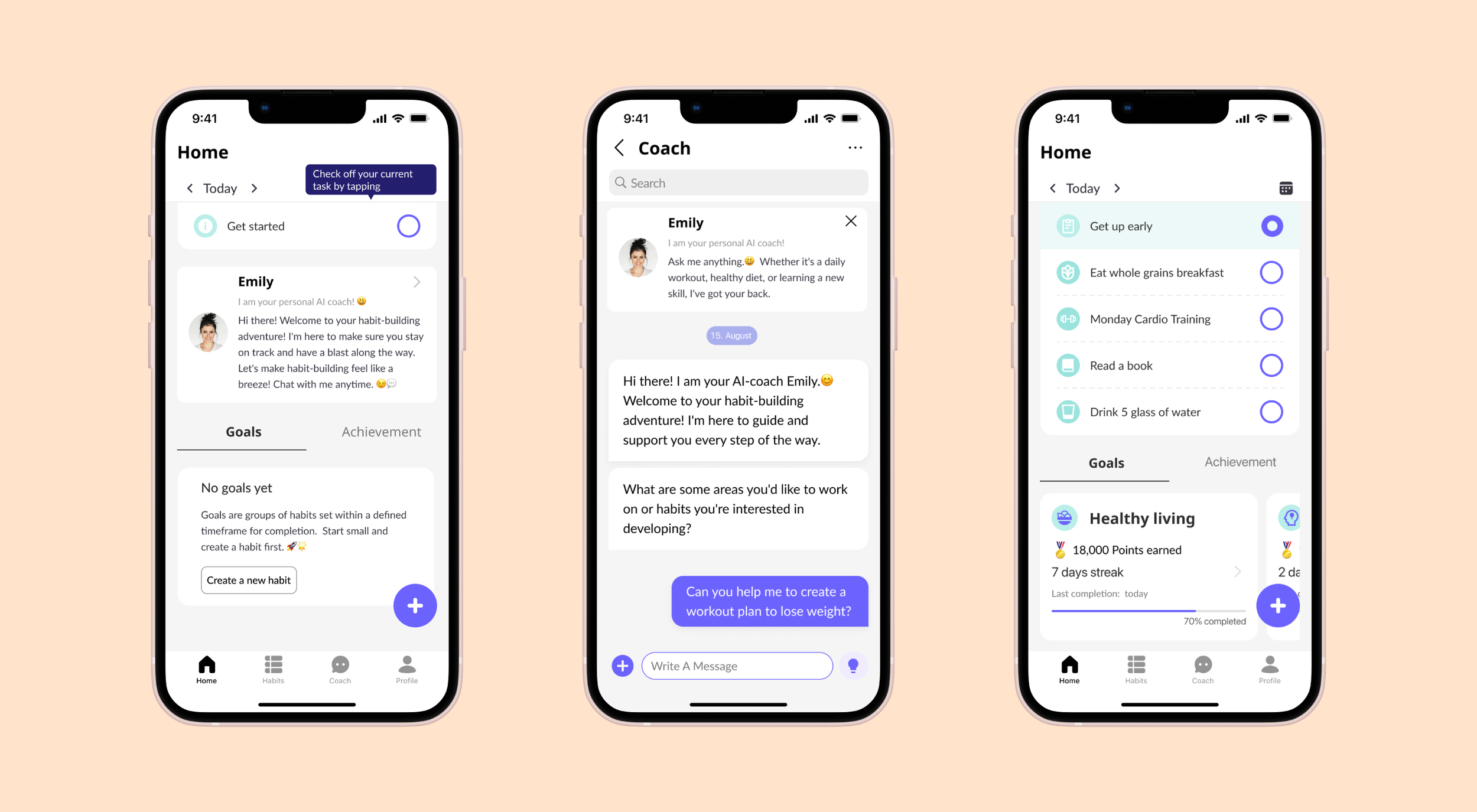
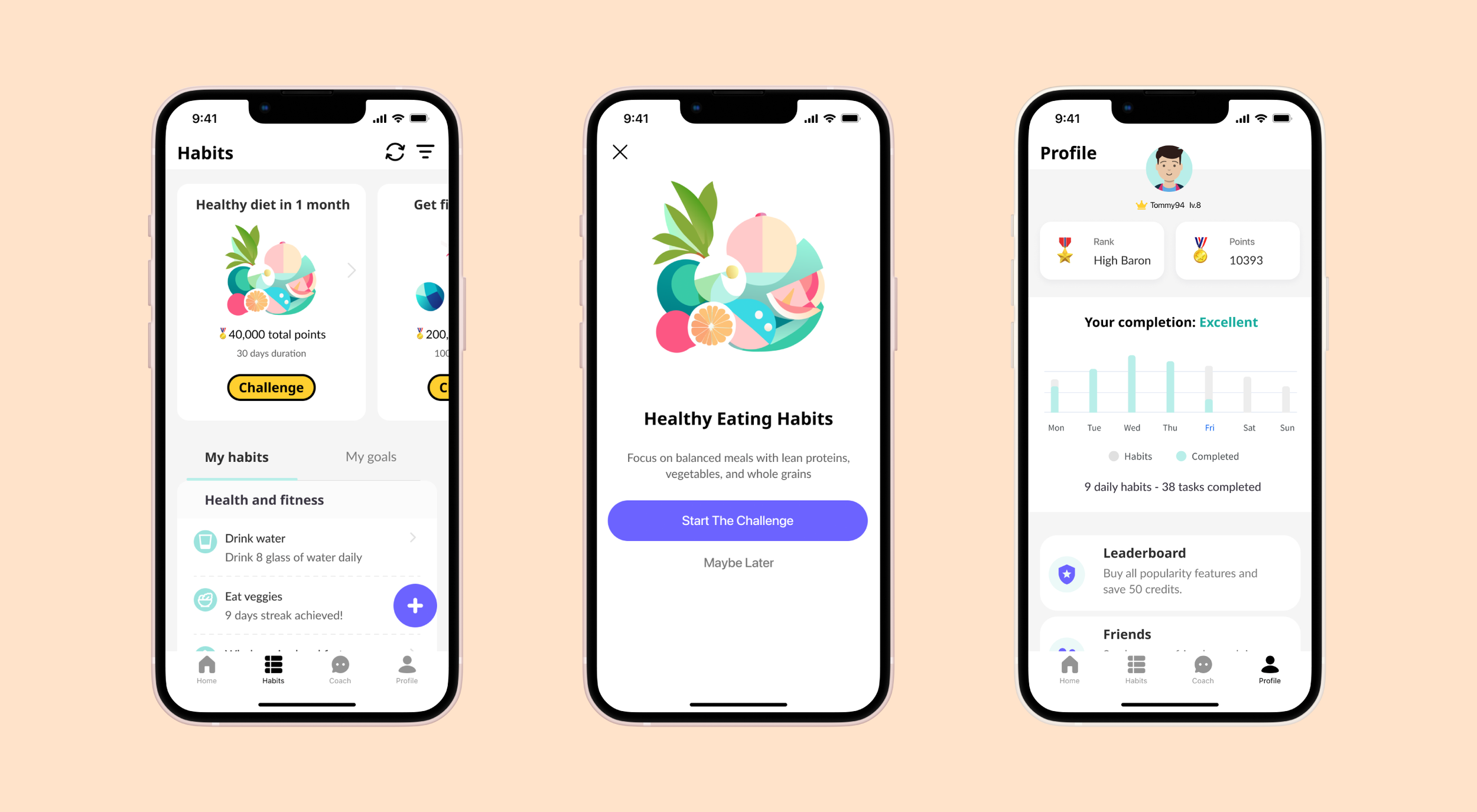
High fidelity mockups
V2.
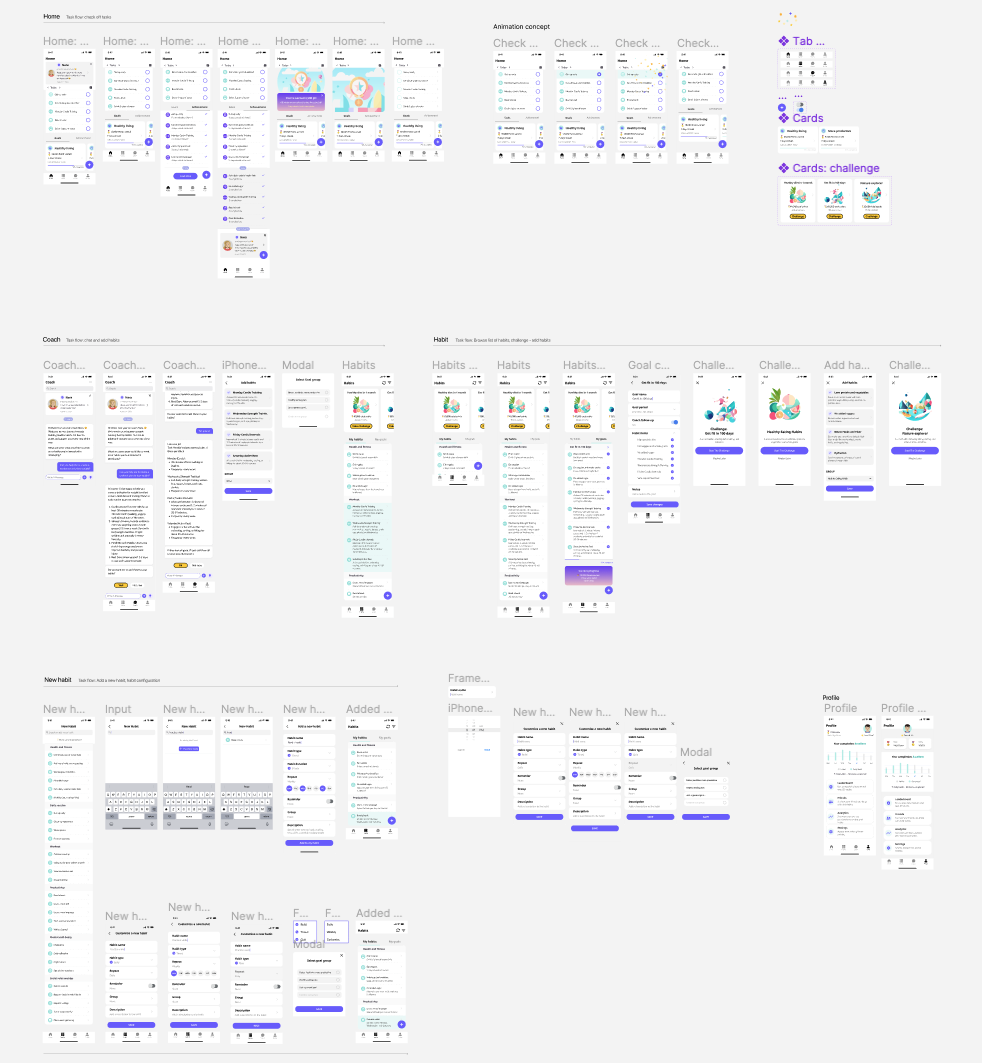
High-fidelity prototype
The fun part!
As I am building these screens I already began to prototype and test on iOS to observe the cohesiveness of the flows. Ultimately, I aim to involve users in testing and gathering their valuable feedback.
The essence of effective prototyping lies in developing something comprehensible and testable by engineers, users, or stakeholders. I use early-stage prototypes (those linearly arranged, not “real-product approximation“ prototypes) to communicate with engineers and evaluate against heuristics as I design.
Refining the prototype
Testing requires prototypes that work like a real product. Testing requires non-linear interaction, which comes with conditional triggers, and advanced variables.
Back in the days (just earlier this year) we had to do a lot of spaghetti prototyping…Thanks to Figma's recent introduction of Variables and advanced prototyping, we're inching closer to achieving a level of precision like Axure RP. My next step is to refine the prototype and utilize advanced prototyping to make it work in a non-linear, functional way.
Testing requires “the real“ prototype
Future testing plan
Recruit participants from Maze/ MTurk to test out the following task flows (only screen recording):
Onboarding, checking off tasks, habit creation, editing habits and goals.
With screen recording and survey answers, it may provide limited qualitative data.
Synchronous remote testing:
I would recruit participants manually and offer a lower compensation, at the cost of more time spent on moderating the testing.
In the event of a higher budget, recruit participants who can do Think-aloud (which requires proper compensation) while testing the prototype. The testing session can be either synchronous or asynchronous.
Asynchronous remote testing:
Simply use usertesting.com or similar services, get recordings with think-aloud, synthesized data all in one place.
Expensive.
1
2
3
4
Reflections
Future work
I noticed that gamification added a great amount of complexity to the system. One thing that is hard to validate with usability testing is long-term motivation. Will the initial “fun“ turn into unnecessary steps for an experienced user? For any gamification product, research is the most important part.
Accessibility
To test the legibility and readability of the visual design and content, I used a contrast checker following accessibility guidelines. The result suggested that contrast ratios on every screen are above 16:1. Additional functions for screen readers and other assistive technologies may be added later.
Gamification and more
This conceptual project is about fun and exploration! I observed many products with successful gamification elements on the market, one thing worth mentioning is social functions. The social function should be included later in this product.